
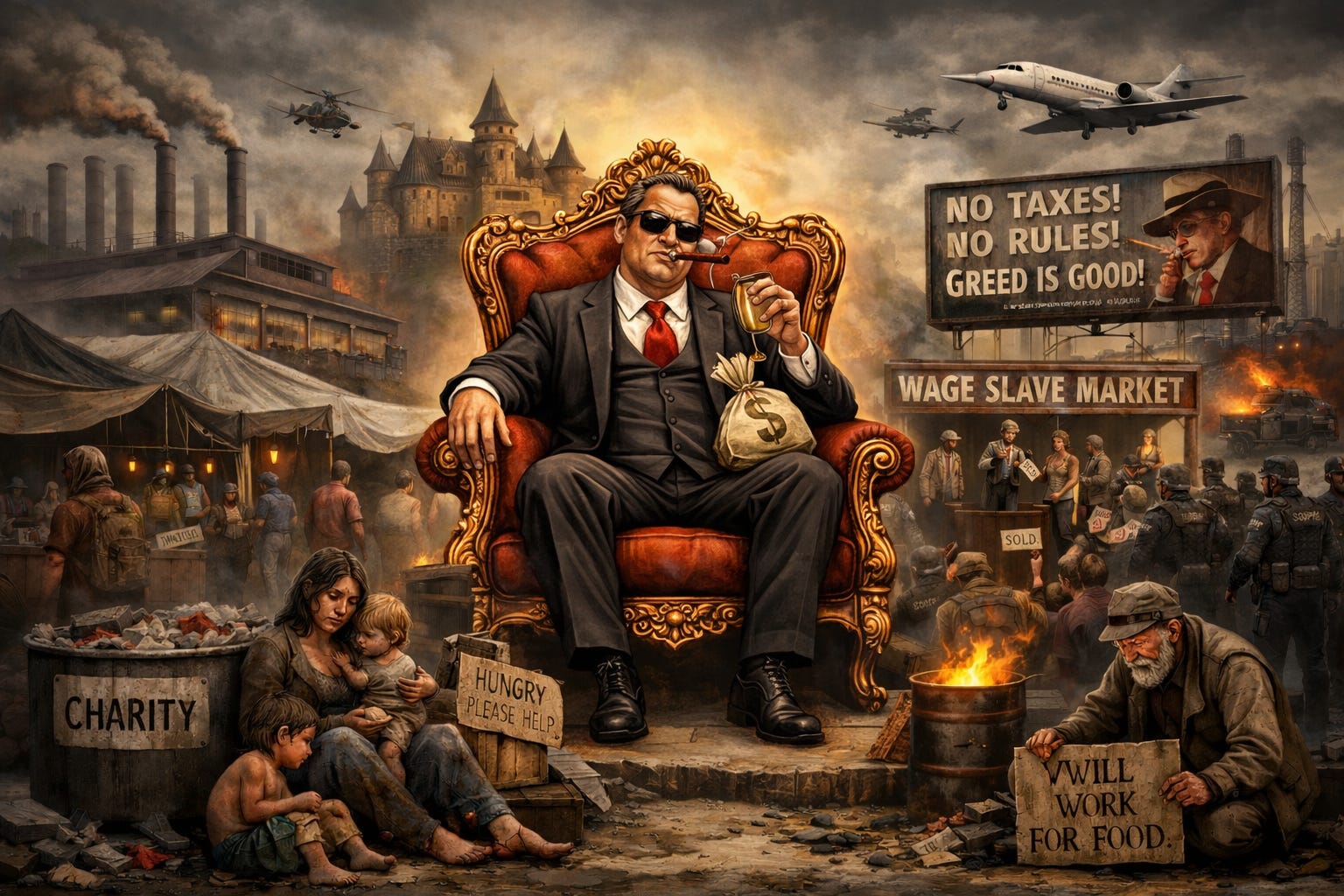
Exposing the Right-Libertarian Hellscape
"Voluntaryism," the "non-aggression principle" and opposition to "state coercion" have become consistent stalking horses for feudalism, minority rule and the violence of oligarchy.

As I celebrate my one-year anniversary on Substack, with 70 published posts, and 789 subscribers—18 of them paid—I want to thank you for your continued support and thoughtful feedback. I couldn’t have done it without you. At first I planned a once-per-week cadence, and I was afraid I couldn’t keep it up for the long-term. As it turned out in 2025, I hit slightly more than one post per week, published my book My Cult Your Cult (Amazon), and even notched my first Substack Live interview with former Congressman Joe Walsh.
I won’t beg you often. If you found my work useful this past year, consider a paid subscription. Writing isn’t the most lucrative career, so every little bit helps. It’s the equivalent of two cups of coffee per month, and you will have my eternal gratitude.
My first article of Year Two hearkens back to intellectual battles with right libertarians that I once fought in the early 2000s, as I sorted out my own politics. I came from a GOP family and background, and it took me some time to get out of that cultish mindset. When I was just past 30, the facade of capitalistic fascism and Christian Nationalism began to crack. Right-libertarianism served as a kind of halfway house—one I later abandoned after recognizing its deep inconsistencies.
As the US dives deeper into Trumpian fascism, we’re facing the same conflict today. “Minimum government,” right libertarians say, without discussing what that government should do and who it exists to protect. Above all, right libertarians seem to be fundamentally anti-system. They have all sorts of complaints and none of them ever say “let’s fix government and make it work for everyone.” Instead they say “fuck government,” with no proposals about what happens after the government is well and truly “fucked.”
It’s no answer, and they have no plan at all. The “non-aggression principle” is actually the non-accountability principle.
We need a new plan now more than ever, since Trump has FUBARed our government. Right libertarians want to fuck it even harder. This is tough to stomach. Small government means big wealth rules the day, while corruption is elevated to official state policy.
Full disclosure, I’m a Left-libertarian. That means while being far to the left of the Democratic party, I still value maximum individual liberty—with a caveat: A strong, accountable state should be used to establish a social safety net below which no one can fall. Food, housing, medical care and a basic income stipend should be considered fundamental human rights for all American citizens.
In a world with GDP exceeding $100 trillion annually, it’s become increasingly obvious that global poverty is entirely human-engineered. It’s an ongoing crime against humanity, and its perpetrators have names and addresses. In large wealthy nations, human flourishing must be placed above the dastardly notion of unlimited private ownership—which has become the sum of all evils.
The world’s billionaires are mathematically, directly and fully responsible for global poverty. They exist at this scale only because governments choose not to tax extreme wealth and the global financial system permits tax havens and other machinations that shield it. I’ll never back down from that stance, because the data prove it. Billionaire charity is a pittance compared to their avoided taxes. Even the most beneficial foundations—Gates, Wellcome Trust, Ford and Open Society—are exceptions that prove the rule. If that wealth were taxed instead, democratic governments could decide how those resources are used.
There’s no function of government more important than using every lever of state power to legally guarantee the shared prosperity of all citizens. Sadly, the Democratic party (while better than Republicans on social spending and inclusion) isn’t anywhere near where it needs to be. Mainstream Democrats are especially timid on wealth taxes—or strictly regulating private capital—refusing to even consider caps on income and net worth. Though I view such policies as essential, they’re far outside the Overton window of the US electorate. Democrats have to win elections in capitalist America—so I force myself to look past their timidity and vote straight-ticket blue anyway.
Yes, it’s the lesser of two evils—which is mathematically the same as the greater good.
But I still find myself considering what would need to happen, perhaps far in the future, to ensure a truly just and equitable society. It would involve restoring steeply progressive taxation of income, annual taxes on wealth, and enforcing a maximum net worth allowed per individual—perhaps something on the order of $100 million—among other regulations. This is not socialism (i.e. government ownership of the means of production), and it would be fully compatible with limited private property and regulated markets. It’s along the lines of the Nordic model of left-libertarian social democracy. My version would be slightly stricter on wealth concentration—in keeping with the recommendations of economist Thomas Piketty in his book Capital in the 21st Century.
Piketty’s historical analysis makes clear that the last time wealth concentration was meaningfully reduced in the developed world, it did not happen through polite debate or incremental reform. It happened because the first half of the 20th century delivered massive external shocks that destroyed capital at the top of the distribution—two world wars, the Great Depression, sovereign defaults, inflation, and postwar financial repression.
Large private fortunes were physically obliterated, heavily taxed, or eroded in real terms, which dramatically compressed inequality and opened political space for broadly inclusive institutions: mass education, social insurance, public health systems, and strong labor protections. The mid-century social-democratic era was not born from elite generosity; it was made possible because concentrated wealth had been forcibly reduced to a level where it could no longer dominate democratic politics. Piketty’s core warning is that absent similar leveling forces—this time achieved deliberately through taxation and policy rather than catastrophe—capital naturally reconcentrates, and with it, political power.
The rich simply cannot be allowed to get ever richer, while promoting massive propaganda through the government and the Republican party—which consistently victim-blames the poor for their poverty. “How will we pay for it?” is always applied to social services, but never to the military or lucrative government contracts with private industry. Work requirements are often imposed for both food-aid and medical care. It’s super ugly and serves billionaire class interests to take full credit for their own success, while labeling most of humanity as worthless “moochers” unworthy of “wasting tax dollars” and possibly even as sub-human. Nietzsche’s Ubermensch is rearing its head again.
Yeah, it’s that bad. Wealth and power warp the mind. The rentier class is the true moocher. You don’t want to know what these would-be Titans actually think of you. You simply can’t imagine the sense of entitlement that a billion dollars buys—let alone a hundred billion.
It’s not a great distance from “if you don’t work, you don’t eat” to the fascist slogan “Arbeit Macht Frei,” wrought in iron above the entrance to Nazi concentration camps. If we can’t do better by our citizens in the 21st century, that negates every bit of tech progress we’ve made. As Buckminster Fuller said, it’s entirely possible for one person to invent something that can support 10 million others. And many such inventions have been realized in the past century. Except those gains have been mercilessly hoarded—and inequality is surging once again to levels not seen since the Gilded Age—as a direct result. What will happen to the working class when a quarter of jobs are automated? How about half? Capitalism has an expiration date, and it might be as soon as the next decade.
We’re not prepared.
Right-libertarianism falsely presents itself as the moral defense of freedom, agency, and voluntary cooperation against a coercive and predatory state. It argues that government is the primary source of social harm, that taxation is theft, and that a society built on voluntary mutual aid would be more ethical and more effective.
The appeal seems intuitive in a world where governments wage disastrous wars, protect corporations, and feel distant from ordinary people. But once these arguments are scaled up to the level of real societies—millions of strangers from a wide variety of cultures, complex economies, advanced infrastructure—the right-libertarian model collapses into feudalism. You’re the peasant, never the Lord.
What follows are right-libertarian claims from a live debate I had on January 31, 2026 with one of the admins of the Libertarian Party Discussion Group. I include my rebuttals grounded in what precisely fosters human cooperation at scale, and how right-libertarians are complicit in vast, preventable sickness, hunger and poverty—which is the real, brutal face of aggression and coercion, worldwide.
The Original Post
“How long will the MAGA brainrot masses blame ‘the left’ or ‘the communists’ for why their lives suck and their salaries are low? Their lives suck because we have a government that tries to solve problems by checks notes making the problems worse. People have to better their lives instead of expecting the government to do it for them. Libertarians believe in strong voluntary communities and institutions that uplift one another. Build mutual aid, act kindly to your neighbor, empower the meek, invest in local businesses, and create something. Individuals have agency. We can create the world we want without the violence of government. Bureaucrats hundreds or thousands of miles away can never do this. They live decadent lives by stealing your labor value through taxation and money printing inflation, then use that stolen wealth to bomb innocents, prop up corporations, and oppress our own population. The government system is evil and anti-humanity and we must do better.”
What I find to be brainrot is the idea that all government is equally bad. It’s a thought-stopping cliché. The size of government is absolutely meaningless. Big governments can be accountable or corrupt, and small governments can protect freedom or entrench oligarchy. The only questions that matter are: Is the government accountable? What are its policies? Who is it primarily for? Is it protecting the strong or the weak?
Volunteerism or mutualism might work in small or kin groups. But any group with a high degree of mutual aid will attract free riders. And within private groups, exclusion is the norm. If free riders aren’t policed, they will destroy the group’s function. If exclusion isn’t prohibited, these groups produce only “club goods.”
Many systems that function adequately at the level of a tribe or village of 150 people break down in a society of millions. That’s why mutual aid became institutionalized into systems like universal healthcare, pension funds, food assistance, and public education.
These are absolutely legitimate functions of a cooperative government. They can be funded with printed money, so long as sufficient taxes are imposed to control the resulting inflation. This is the central thesis of Modern Monetary Theory: the limits of social spending are always labor and resources, and never financial. Currencies are just accounting systems for value that already exists as economic potential. Social spending generates a multiplier effect that supports economic growth.
It’s really tough to understand why this isn’t bald-faced obvious. What’s wrong with standardizing everyone’s contribution? The only objection could be if you actually hate the idea of everyone having enough—and the wealthy getting just a bit less rich. Sounds lovely to me.
Rule of Law
“Is cooperation moral if it requires it be demanded through force?”
By definition, any law has to be enforced, or it’s not a law. So yes, principled use of force is moral when backed by popular sovereignty (majority vote). It goes back to the failure of voluntary systems to be able to police free riders and abusers.
You could have a perfect voluntary system functioning for years with a couple of dozen people in a community, and all it takes is one asshole to ruin everything. Those couple of dozen people would be within their rights to band together and use force to eject or contain the asshole. Scale this up, and you have government.
The work of anthropologist Richard Wrangham is relevant here. He wrote The Goodness Paradox on the topic of human self-domestication. Sometime around 200,000 years ago, people in early societies began to work together to eliminate (kill) troublemakers, specifically those with high levels of reactive aggression. With those genes out of the pool, proactive aggression began to dominate, and still does.
It’s why 100 humans can mostly sit on a plane in close quarters for hours without killing each other, whereas 100 chimpanzees cannot. That’s why it’s called The Goodness Paradox. Because in order to be “good” we had to learn to use force to eliminate those who would do harm. This is fundamentally behind Hobbes’ theory of granting the state a monopoly on violence. It’s not just a good idea. It’s tied to our evolution.
Harm Reduction and Moral Agency
“So you believe pre-emptive violence to force cooperation is ethically sound? Remove all agency of the individual to voluntarily help a fellow man and all value of the action becomes meaningless. If someone is drowning, is it morally acceptable for armed authorities to tell you, either you go in and save the drowning person, or we will kill you?”
Systems never remove agency. They only improve incentives. There are all sorts of valid thought experiments to test this theory, like trolley problems:
Pulling a lever that will kill one person to save five is ethical when everyone is already in jeopardy, meaning someone’s going to die no matter what. The least harm principle always applies.
Change the thought experiment, the ethics change: Pushing a fat man off a bridge to stop the trolley is the same math, but very different because the man on the bridge wasn’t in jeopardy to begin with. Not ethical.
There are even worse examples: grabbing a person off the street to harvest their organs to save the life of five people in the hospital, for instance.
The drowning man at gunpoint scenario is most similar to option three. Involving a bystander by force in that manner would be immoral. We should encourage heroism to save lives but not demand it.
Here’s a better question: Does society have the absolute obligation to feed hungry children, even if it involves taking a bit of food away from everyone? I would argue yes. Even though you’re still involving bystanders, it’s tied to a very affordable sacrifice for the common good. Everyone has a vested interest in being sure the next generation is properly fed.
So I would absolutely use force (in the form of taxation) to be sure all children are fed. Oppose this, and it’s tough to see how that’s any different from wishing children to starve. Right libertarians dodge this question constantly.
“Should people be tortured to force them to feed the poor?”
“What happens if all people refuse to work because they feel their labor is being stolen? Will you torture them to get them to work to feed the poor?”
We don’t have to torture people to get them to feed hungry children. Just tax them.
But that’s the wrong question—a classic right-libertarian straw man. Notice he changed from “children” to “the poor,” a classic dodge. Kids are tough to pin down with the Puritan work ethic, because that forces right-libertarians to either concede the argument—or endorse child labor—which they often do. They also tend to support eliminating the minimum wage.
But let’s get back to the only question that truly matters:
Does society have a moral obligation to feed hungry children?
The answer is always and forever yes. This involves measurable outcomes, clear peaks and valleys of well-being, and competing moral claims about responsibility and intervention. In a world with an annual GDP exceeding $100 trillion, millions of children are still not fed. Global hunger could be eradicated for roughly $40 billion per year—less than 0.04% of GDP.
This sum should be removed from the accounts of the world’s billionaires—TOMORROW.
If morality concerns the well-being of conscious creatures grounded in empirical facts, then childhood hunger represents a deep valley on the moral landscape. The scientific evidence is unequivocal: hunger in childhood harms physical and cognitive development, emotional well-being, and life outcomes.
Failure to feed hungry children undermines the moral capacity of future generations. A hungry child who survives becomes a damaged adult. This creates a vicious cycle. Imagine a leader who suffered malnutrition as a child cancelling a food-aid program by saying, “Toughen up! I didn’t have enough to eat, and I turned out fine.”
Theft and Consent
“Taxation is theft. Contracts require consent.”
These are the top two most destructive right-libertarian arguments. They are false, intellectually dishonest, and childish. It’s not that anyone likes taxes, or that people should generally be forced into honoring contracts they didn’t sign. But this is a category error. Laws that apply to everyone are implied contracts and there is no opt-out. For instance, I never explicitly agreed to drive the speed limit, but I’m still required to. I never agreed not to steal or kill, but those actions deserve the same consequences as if I had signed a contract.
No one consents to be born. But once you are an adult, you are legally responsible for your relationship to the country in which you live. You inherit citizenship like you inherit genes, but at age 18 you gain full legal agency. From that point forward, every time you vote, pay taxes, drive on public roads, use public parks, or apply for licenses, you are demonstrating consent to live under that system’s rules.
You may not like the rules, but continued voluntary citizenship, once you are legally free to leave the country, is consent in any meaningful civic sense.
Taxation is also an implied contract. Want to opt out? Quit using roads, fire departments, schools, or health-care facilities. Don’t live in a house on which you must pay property taxes. But even then, you are still protected by state military expenditures. There is no way to fully opt out, which is why taxes can’t be optional.
Without taxes, no civilization is possible at scale. We are no longer hunter-gatherers who can just live off the land and work things out informally in small groups. Specialization within large-scale society makes governance and taxation essential.
This shouldn’t even need to be said. But the billionaires keep clamoring for even more tax cuts. And under Republicans and/or right libertarians, they tend to get them.
Nothing Fails Like Charity
“Charity and voluntary systems would replace government programs.”
If private charity could reduce poverty, then with tens of billions a year in private charity worldwide, why do we still have poverty? Because it’s still considered a “gift,” instead of an obligation.
The wealthy toss their table scraps at the poor to get a tax deduction. But why should we have food drives and private food banks and “never enough” donations, when governments have it in their power to give people an unconditional food allowance—to ensure that no one has to think about hunger ever again?
Charity is voluntary, and voluntary systems reliably leave children hungry even in societies with enormous private wealth. Consider the constant fulmination in some states over “school lunch debt,” which should never exist. That makes it a moral design failure. Does children’s consent not matter? Children were never asked if they wanted to experience deprivation, and they cannot legally work to feed themselves. A functioning society makes sure kids are in school with full stomachs every single day without fail. And it does not make their well-being dependent on whether some mucky-muck feels generous that day.
The discretionary nature of charity is the failure mode. Access depends on donor preference rather than severity of need, leading to discrimination and favoritism. People tend to donate most generously to their “in-group” and avoid giving to the “out-group.” It’s completely unacceptable to hold the weakest and most vulnerable citizens hostage to such whims or ideology.
This is why every single example of private charity is diagnostic of government failure. Food, housing, education and health care are national budget line items, and can never be considered “optional.”
Right Libertarians Openly Reject Democracy
“I reject majority rule. I reject rule of any human over another. Libertarianism rejects coercion as a principle.”
When you reject both majority rule and coercion, you remove the only mechanisms societies have to guarantee food, housing, and economic security. De facto, that means kids don’t get fed, the poor don’t get housed, and displaced workers are left to fend for themselves.
Lack of coercion is definitionally lawlessness. And it leads to poverty and misery for the majority. History tried the “no one rules anyone” model. It produced kings, warlords, and peasants. Because power never sleeps.
Non-aggression and non-coercion have utterly failed in practice and the proof is all around us. Large-scale societies either use collective power through accountable institutions to guarantee basic conditions of life, or they leave those conditions to markets and charity. One path is imperfect and political. The other reliably produces entrenched inequality, preventable suffering, and the quiet normalization of avoidable harm.
The Assignment
It’s time to get much more comfortable with coercing the wealthy out of the lion’s share of their ill-gotten gains. That means imposing heavily redistributive taxes and exposing the vast untaxed money flows into offshore accounts. It’s a den of thieves impossible to fathom unless you take the time to fully understand the insane magnitude of the problem. Trillions of dollars disappear every year into tax havens. Until we stop this bleeding, conditions on Earth will continue to deteriorate year-on-year.
“No Kings” in modern terms means no billionaires. Anywhere on Earth.
This is the crux of left-libertarianism. It recognizes that if “Liberty” costs money, then the poor are systematically denied that Liberty: healthy meals, a home, clean water, and medical care. Whereas right-libertarians are most concerned about “freedom from” taxes and government regulations (negative Liberty), they tend to ignore “freedom to” (positive Liberty), which requires adequate resources delivered to every man, woman and child.
It’s therefore clear to me that right-libertarians don’t care about “Liberty” at all. In their own words, they can’t even be bothered to support democracy, because they believe it’s wrong to “coerce” anyone, even into doing the right thing. Their platform will never uplift the poor, and always favors the wealthy and powerful, no matter how much they prattle on about “non-coercion.”
The final example hits the hardest: Abolishing slavery required the ultimate in coercion—a literal Civil War to wrest “private property” away from the oligarchs of the day, which in the 19th century included human beings. The value of the four million freed slaves at emancipation was around $20 trillion in 2026 dollars. More valuable than all 19th-century American railroads and factories—combined.
If we could make the leap to expropriate $20 trillion in criminally obtained “private property” in the 1860s, there’s no reason we can’t conceive of doing it again today—because modern fortunes are also built through systematic theft from the commons, wage theft, financial fraud, tax evasion, regulatory capture and crime shielded behind the corporate veil.
Modern wealth is no more ethical than slavery itself, and its effects are deep and devastating. It’s the ultimate in coercive power.
Once you wake to this truth, nothing can put you back to sleep. Because billionaires have become—quite literally—world destroyers. And too many of us still consider this “normal.” Heroic, even.
It’s time to emancipate the roughly $50 trillion in modern capital that’s been stolen from the American poor and middle class since the 1970s, and put it to work for the people. Everything that would make a good and equitable society is on the other side of this critical imperative. And still, no American political party is even proposing it.
Whether or not this happens in our lifetimes, it has to happen. Whether or not it sounds like a pipe dream—it does—now you at least understand the assignment.
This is right on. What we need is a New Deal to get rid of the Reagan era oligarchy.
We need:
Steep progressive taxation (top rates >90%)
Strong unions
Public housing
Universal education
Social insurance
Financial regulation
Capital controls with Universal Basic Income. (Good old Andrew Yang ran on this and we need it now more than ever.)
As you state we need mandatory redistribution enforced by law.
Shared prosperity followed elite constraint—not elite freedom.
Very informative and empowering. Right libertarianism is a Trojan horse full of billionaires. I greatly enjoyed your article and would like to support you, but lack resources for full time support. Would you be willing to look into "buying me a coffee" as a way to contribute for those of us who can't contribute all the time? I would certainly buy you that coffee!