
The X Coup
We are now in Elon's mirror universe

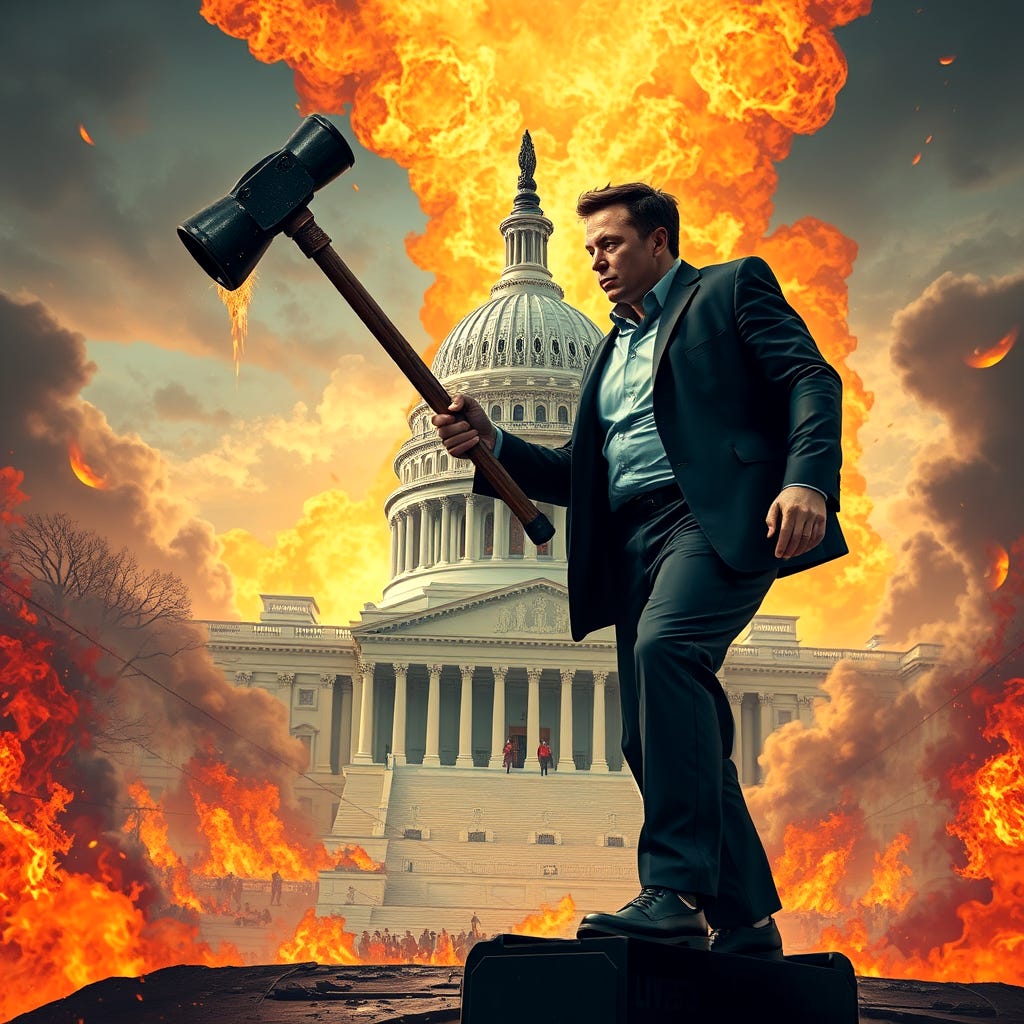
Some events defy description. We’re far beyond cliches about fascism, Nazi salutes, and whatever that evil mind-suck X site has become. It’s beyond a five-alarm fire. Whatever we used to think of as the US government is gone. Destroyed in mere hours in an orgy of retribution against decency, common sense, accountability, and the founding principles of a government of, by, and for the people.
This is no time to avoid hyperbole. We’ve just witnessed a fait accompli.
We won’t understand the full consequences for some time. Hell, at this point it’s difficult to even take inventory. But whatever the long term implications might be—you won’t like any of it.
Here’s what we know. The Trump transition has turned into a comprehensive slashing and burning of the federal government, executed at breakneck speed and with overwhelming force. We have 900 pages of what the Heritage Foundation told us they were going to do, but it’s a certainty there are thousands more pages of dastardly plans they didn’t publish. And none of that even includes Elon Musk’s own planned depredations. The Trump administration, now fully backed by billionaire oligarchs, has moved with stunning precision to seize control of America’s most powerful institutions, gut its civil service, and install ideological enforcers at every level of the federal bureaucracy.
It’s just as they said they would. Not only should none of this be a surprise—they bragged about it. And American suckers who voted for MAGA didn’t care.
The most brazen power grab yet has just unfolded inside the U.S. Treasury Department, where Elon Musk physically entered the building and attempted to access critical government financial systems. His demands were initially resisted by Treasury officials, but when acting Treasury Secretary David Lebryk attempted to block his access to the Bureau of Fiscal Service computers, he was forced to resign on the spot. The implications of this are staggering: Musk now holds extraordinary power to monkey-wrench federal financial infrastructure, putting everything from economic policy to national debt management into the hands of a single unelected saboteur.
Across the federal government, the situation is dire. In just the past 72 hours, mass purges have begun across multiple federal agencies. Countless career government employees have been summarily dismissed, particularly those in roles related to environmental policy, labor protections, and diversity initiatives. Employees at the Department of Education have been placed on leave merely for having partipated in past Diversity initiatives.
The Office of Personnel Management (OPM) has issued directives to scrub all federal agency websites of DEI-related content and has instructed government workers to report any efforts to disguise DEI programs under new terminology. Employees who refuse to comply have been warned of “adverse consequences,” though the full extent of these repercussions remains unclear. Unconfirmed reports suggest that AI-driven surveillance systems may already be monitoring internal government communications, scanning for ideological violations and flagging employees for dismissal.
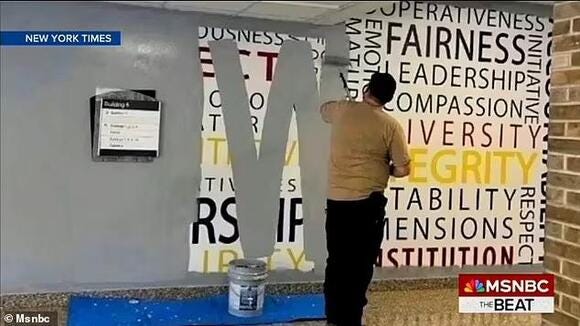
Under the guise of purging “gender ideology,” vast amounts of public scientific data has been removed from government websites. At the FBI, workers painted over a wall which included the term “diversity.” It’s tough to imagine a starker symbol of the coup-in-progress than this photo:
At the same time, the administration’s newly announced 25% tariffs on all imports from Canada and Mexico have sent shockwaves through North American trade networks. The U.S. does nearly $1.5 trillion in annual trade with its two closest neighbors, and overnight, that system has been thrown into chaos. Key industries—including automobiles, agriculture, and energy—are now facing total disruption. Canada has already announced retaliatory tariffs on U.S. exports, while Mexico is still formulating its response. If this continues, the consequences will be catastrophic: the automotive sector alone accounts for over $600 billion in trilateral trade, and industries that rely on cross-border supply chains—everything from food production to manufacturing—now face potential collapse.
For now, the stock market has not yet had time to react, and the price effects of the tariffs have not yet hit consumers. But this won’t be the case for long. Once businesses absorb the impact, price spikes are inevitable. Food costs (and everything else) will soar as tariffs drive up the price of imported goods, while American manufacturers—already struggling with supply chain constraints—will be forced to either pass higher costs onto consumers or shut down production entirely.
The normal checks and balances that should prevent this from happening are failing under the sheer speed and volume of these actions. Congress, now fully controlled by MAGA-aligned majorities in both chambers, has yet to respond in any meaningful way.
Judicial oversight remains a possible avenue. The Supreme Court has not yet weighed in on the legality of any executive actions, and it remains to be seen whether the judiciary can still be a functional check on power.
The sheer speed of events has left Americans struggling to grasp what is happening. But if the administration continues down this path without resistance, these changes will become irreversible. The federal government is a massive and complex machine, with over two million employees. As MAGA minons slash and burn, the brain drain and loss of critical systems will be staggering. And it’s an open question whether any of it can ever be put right again. We’re barely two weeks into this coup, and these people will be in power for another four years.
Everyone should banish the phrase “wait and see.” We all knew this was coming from the moment Trump won the election.
History has already provided a blueprint for how this will play out. In the 1930s, the world saw a similar pattern: economic collapse, nationalist policies that worsened the crisis, and the rapid dismantling of democratic institutions in favor of authoritarian rule. Those who understand the lessons know this is inevitable. Trump’s tariffs will unleash war. It’s not if—it’s only when.
This is a lesson every college student learns in Econ 101, and Intro to International Relations. Tariffs are sheer poison to the global economy. They even have a nickname: “beggar-thy-neighbor” policies. And who pays tariffs? Consumers, every single time.
In 1930, the United States passed the Smoot-Hawley Tariff Act, imposing steep duties on over 20,000 imported goods. Intended to protect American industries, the law instead provoked swift retaliation from trading partners. U.S. exports fell from $5.2 billion in 1929 to $1.7 billion by 1933, a nearly 60 percent decline, as Canada, France, and Germany countered with their own tariffs. Canada, once the largest importer of U.S. wheat, shifted its purchases to Argentina. European nations targeted American industrial goods, further damaging sectors like automobile and machinery manufacturing. Instead of preserving jobs, protectionism led to factory closures, rising unemployment, and deepening economic contraction.
The economic impact extended well beyond the United States. Weimar Germany, heavily reliant on exports and foreign investment, faced catastrophic consequences. Already burdened by war reparations, Germany saw capital outflows accelerate, and with major markets closed, unemployment soared from 1.9 million in 1929 to over 6 million by 1932, leaving nearly a third of the workforce jobless. Industrial production collapsed by almost 50 percent, and the country’s financial system teetered on the brink, culminating in the 1931 failure of Danatbank, one of Germany’s largest financial institutions. Political instability followed. As democratic leaders failed to restore economic stability, extremist parties surged. The Nazi Party, which had garnered just 2.6 percent of the vote in 1928, became the largest party in the Reichstag by 1932 with 37.3 percent support. By 1933, Adolf Hitler was Chancellor, and within months, democratic institutions had been dismantled, placing Germany on a path toward military rearmament and territorial expansion.
Japan faced an equally severe crisis due to its dependence on international trade. By 1930, nearly half of its export revenue came from silk sales to the U.S., but as American demand plummeted, silk exports fell by over 50 percent. The economic collapse devastated Japan’s rural economy and textile industry, leading to widespread layoffs and social unrest. With trade barriers rising and foreign markets closing, Japan’s leadership turned to military expansion as an economic strategy, arguing that territorial conquest was necessary to secure access to vital raw materials and resources.
In 1931, Japan manufactured the Mukden Incident, a false-flag attack on its own railway in Manchuria, to justify a full-scale invasion. The military swiftly occupied the region, establishing the puppet state of Manchukuo in 1932, securing access to coal, iron, and agricultural resources. The League of Nations—the only global institution tasked with maintaining stability—condemned Japan’s actions but was unable to impose meaningful sanctions. Paralyzed by the global economic crisis, major powers lacked both the political will and financial strength to enforce international law. Britain and France, struggling with unemployment and debt, saw no appetite for intervention. The United States, focused on its own domestic crisis, remained on the sidelines. With no consequences for its actions, Japan withdrew from the League of Nations in 1933, openly rejecting international constraints.
This collapse of multilateralism emboldened other expansionist states. Germany, closely observing Japan’s success, recognized that the League was powerless to stop territorial aggression. As the Nazi government rearmed in violation of the Treaty of Versailles, the lack of enforcement encouraged further defiance. In 1936, Germany remilitarized the Rhineland, a direct challenge to the postwar order. The same year, Japan escalated its military campaign in China, culminating in the Second Sino-Japanese War in 1937. The League once again failed to act decisively, reinforcing the idea that expansionist powers could seize territory without consequence.
By the late 1930s, Germany and Japan had fully transitioned to militarized economies. Germany’s massive public works projects and rearmament drive, coupled with Japan’s push for territorial control, made war increasingly inevitable. In 1939, Germany invaded Poland, triggering World War II in Europe. Two years later, in December 1941, Japan attacked Pearl Harbor, bringing the U.S. into the war. Both conflicts were the culmination of a decade of economic collapse, failed trade policies, and the unchecked militarization of authoritarian regimes.
The Smoot-Hawley Act played a direct role in exacerbating the global economic crisis that enabled these developments. By strangling trade, it accelerated economic desperation, weakened international cooperation, and created the conditions for political radicalization and military aggression. The League of Nations, already fragile, lost credibility as the world’s leading economies turned inward, breaking down the mechanisms that had kept expansionist ambitions in check.
The lesson is clear: economic nationalism and protectionism do not create stability—they create crises. When international trade collapses, economies shrink, unemployment soars, and political extremism rises. When multilateral institutions fail, expansionist states exploit the vacuum. And when global powers hesitate to confront early acts of aggression, they all but guarantee a larger conflict. The path to war in the 1930s was not inevitable—but it was the direct result of economic isolationism, failed diplomatic enforcement, and the misguided belief that trade restrictions could shield nations from global instability. The cost of that failure was a world war.
I am going to repost this everywhere I can. This is as scary as anything I have read.
We understand. Today.